ROBOT 1981
The Story of the μ-Amp
The μ-Amp began as an onboard guitar preamplifier project in 1981. Its history is also the story of the people behind it, the music around it, the ROBOT name, and the work now being done to bring the project forward again.
THE PEOPLE, THE PROJECT, THE RETURN
More than a circuit diagram.
The clearest way to tell the μ-Amp story is chronologically and personally: first Bill Sweeney, then Frank Davies, then the ROBOT project itself, followed by the present revival and where the project may go next.
BILL SWEENEY
Musician, teacher and co-creator.
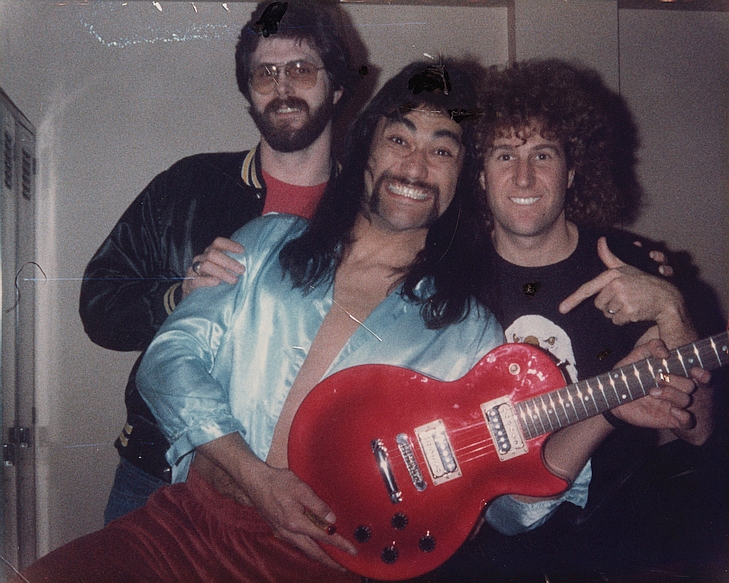
Bill Sweeney is the director of the Olympia Conservatory of Music. He is also known as “Metaldude” and has spent much of his life performing, teaching guitar, sight-reading and music theory.
His public performance history includes the cover bands Tommy Denton and the Kentuckians, Anita Rae and the Country Gentlemen, Sweeney and the All-Beef Weenies, early Spoonfed, Banzai Dogs, Dark Angel, No Amnesty, Pump House Blues Band, Black Label and Don Barton Sr. His original artist bands include Abaddon, Jusdefy, the Dudes, and Union with Cindy Garay.
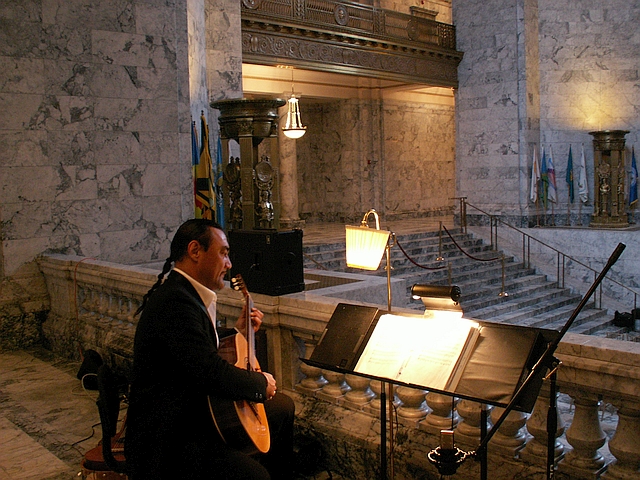
Bill has also performed nylon-string fingerstyle and classical guitar duets at many student recitals and professionally at venues including the Capitol Rotunda, Schmidt Mansion, Carriage House, Woodland Park, Sitka Convention Center and Washington Performing Arts Center.
His teaching work has included Westside Music, Yenney’s Music, Tumwater Music and Music & Arts in Lacey. He has served as adjunct faculty for South Puget Sound Community College and Evergreen State College Independent Studies, and has taught community education through SPSCC, Pierce College and Lacey Parks.
He currently teaches through Olympia and Tumwater community-education programs and continues building a base of private students at the Olympia Conservatory of Music, which he co-founded, owns and directs.
FRANK DAVIES
Guitarist, teacher, maker and co-creator.
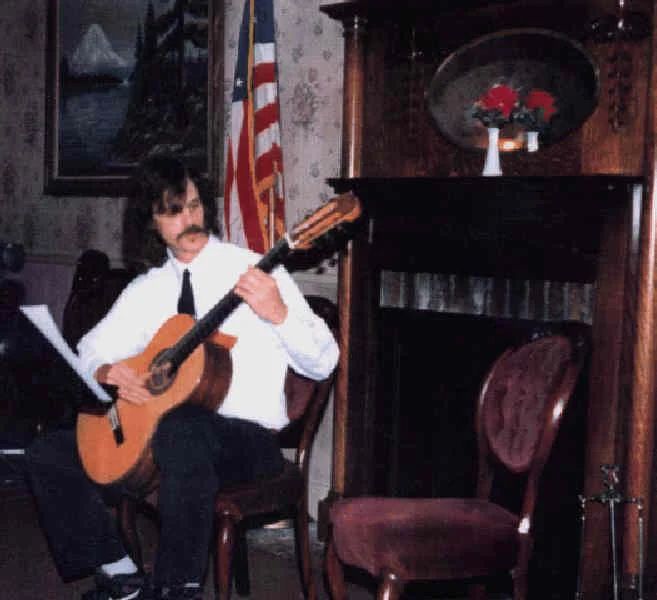
Frank Davies has been playing guitar since first watching the Beatles on The Ed Sullivan Show while he was in the fifth grade. He later studied classical guitar performance for four years at Virtuoso Studios in Olympia, Washington, under the direction of the late Rick Riley, and attended a master class presented by Chilean virtuoso guitarist Patricio Contreras.
Frank’s debut performance was playing classical guitar for a production of Don Juan at the Washington Center for the Performing Arts. He also performed as guitarist in Rick Riley’s Vivaldi Trio and has performed locally as a classical guitar soloist.
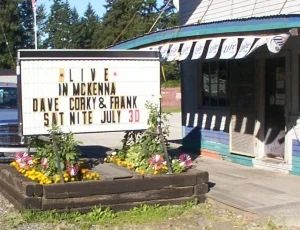
He is also an avid bass player, having performed in the Cory Buckner Trio and as bassist for DFC, the house band at Walt’s Place in McKenna, Washington, for about a decade.
Frank has taught group classes in classical guitar performance at The Evergreen State College and Music 6000, in addition to teaching private students through several other music stores. He was an original co-founder of the Olympia Conservatory of Music and also co-founded the United States portion of the Karaoke World Championships, KWCUSA.
His work with musical instruments extends beyond performance and teaching. Frank manufactures a solid-body classical guitar along with several other musical products.
Technical and manufacturing background
Frank’s technical interests began well before the μ-Amp. He studied logic while still in junior high school and electronics as a junior in high school. During that same year he worked at KGY Radio in Olympia under Chief Engineer Don Jones, who taught him how to make printed circuits.
As a high-school senior, Frank served as the teacher’s assistant for the physics class and continued studying electronics during the period when his work was moving from vacuum-tube circuitry toward transistors.
At Central Washington State College, Frank was one of nine freshmen accepted into the General Honors Program. Among his studies there was one-on-one work in transistor growing under the direct supervision of a nuclear physicist — an unusually hands-on introduction to semiconductor technology at the beginning of the 1970s.
His background outside music continued to cross electronics, computers, drafting, accounting and manufacturing. In the mid-1970s he studied computer programming, accounting, mathematics, electronics, chemistry and technical report writing at the Olympia Technical Institute, later continuing with calculus and additional studies in electronics and physics and earning an Associate in Applied Science degree.
His early technical work included computer programming, accounting systems, drafting and survey work. In 1980 he worked for Swift Engineering, where his duties included accounting, surveys, drafting and programming. By 1981 he was designing and producing digital and analog circuits for restaurant applications — work that belongs directly to the period in which the original μ-Amp and ROBOT projects were taking shape.
In 1984 Frank started a company producing injection-molded thermoplastic parts. Later work expanded into website development, marine fuel-system projects, and supervision of automatic-gate and ornamental-iron work. He founded AutoGate NW in 2003 and is a licensed electrical administrator and electrician. That mix of electronics, fabrication, business and hands-on product development has continued to influence the way he approaches musical products and the present μ-Amp revival.
Each summer he hosts the private Caronapalooza Party, a weekend camping and music gathering for local musicians, their friends and families.
Frank also composes and arranges music and is currently working on producing an album in his studio.
ROBOT 1981
The original project.
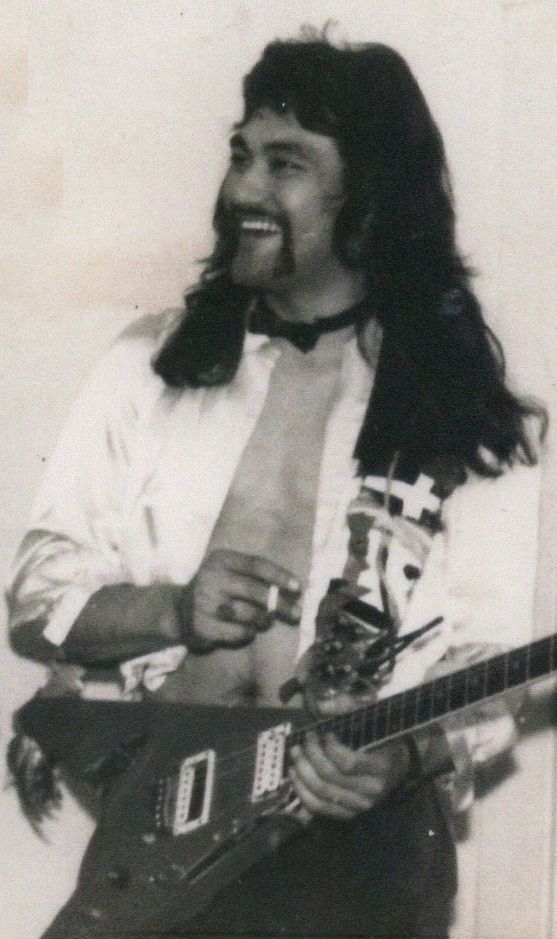
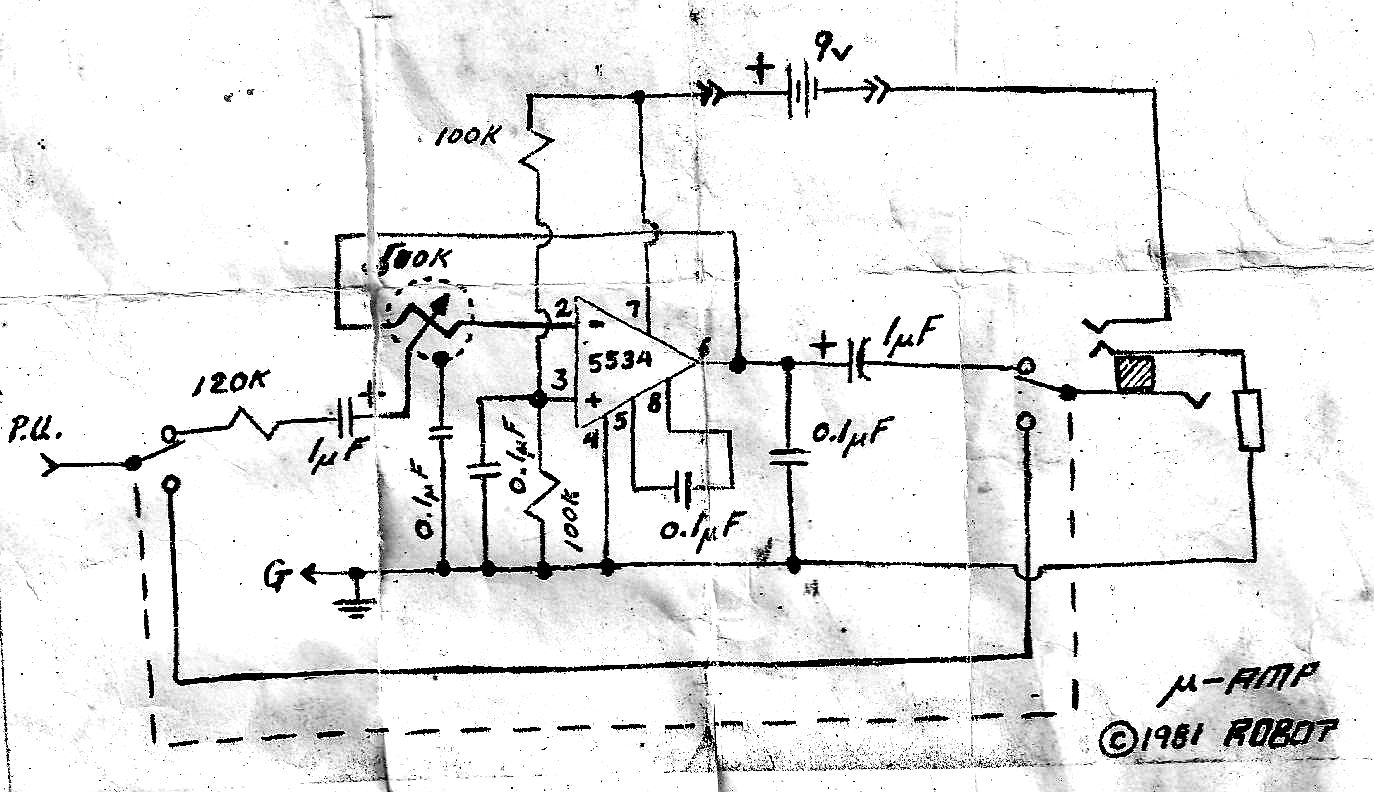
The original μ-Amp circuit survives in period documentation, including the hand-drawn schematic marked © 1981 ROBOT. As the history is reconstructed, this section will document the ROBOT name, the original product concept, the early boards and packaging, and how the μ-Amp was originally intended to be installed and used.
THE RETURN
Revisiting the μ-Amp decades later.
The present project began by returning to the surviving circuit, artwork, photographs and memories and asking a simple question: what would it take to make the μ-Amp understandable, buildable and usable again?
The work now includes a newly documented PCB, installation wiring, instrument-specific package planning, technical notes, a Modder’s Field Guide, component research and a renewed effort to preserve the history rather than letting the original project disappear into a box of old parts and papers.
WHERE IT STANDS NOW
Preserve the original. Improve the presentation. Keep developing.
The μ-Amp is presently being revised as both a historical project and a practical guitar product. The goal is to preserve the original circuit and ROBOT history while improving the PCB documentation, installation choices, parts packages and technical information available to a new builder or player.
Future work will include completing Bill’s and Frank’s histories, identifying and photographing surviving original material, refining guitar-specific installation packages, documenting component choices, and continuing to test how much of the original idea can be carried forward without losing what made the 1981 μ-Amp itself.